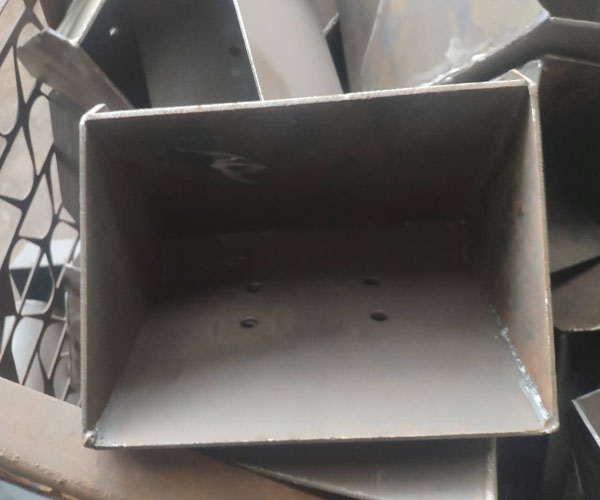
The customization of lifting buckets requires drawings, primarily due to the following core reasons, which permeate the entire process of design, production, installation, and use:
1. Communicate requirements accurately to avoid misunderstandings
The blueprint serves as the "technical language" between the customer and the manufacturer. By meticulously annotating parameters such as dimensions, structure, material, and load-bearing requirements, it ensures that both parties reach a fully consistent understanding of the specifications and functions (such as conveying capacity and tilt angle) of the lifting bucket, thereby avoiding rework or errors caused by vague verbal descriptions.
2. Guide production and processing to ensure process feasibility
The manufacturing of lifting buckets involves processes such as cutting, welding, and bending. The drawings must specify the processing accuracy of each component (such as hole position tolerance and plate thickness), connection methods (such as bolt fixation or welding), and special process requirements (such as anti-corrosion treatment). Manufacturers develop production plans based on the drawings to ensure that each process meets design standards.
3. Verify the rationality of the design and optimize performance
When customizing an elevator bucket, it is necessary to consider the actual application scenarios (such as material characteristics and equipment compatibility). Drawings can be verified in advance for structural strength, center of gravity distribution, and other aspects through 3D modeling or mechanical analysis, to avoid deformation, fracture, or low efficiency caused by design defects during use.